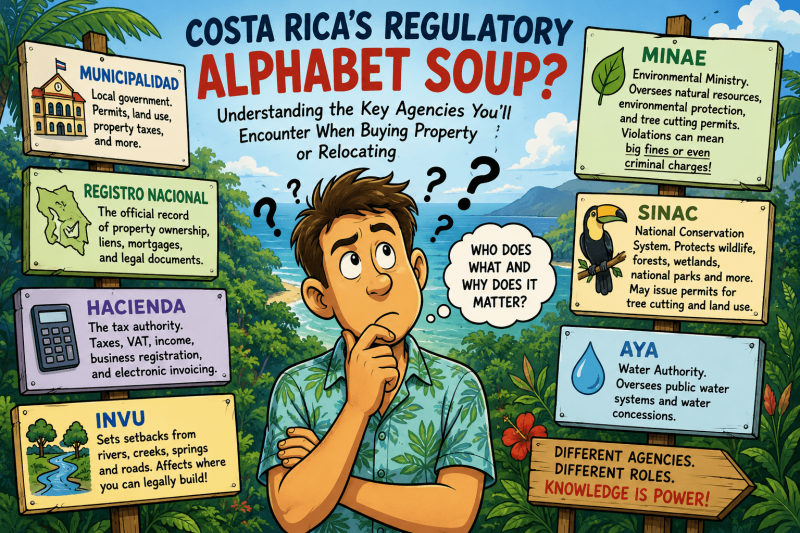
A Practical Guide to the Agencies, Approvals & Bureaucracy Behind Costa Rica Real Estate
If you spend enough time researching Costa Rica real estate or relocation, you’ll eventually start hearing a confusing stream of acronyms and government entities thrown around in conversations:
- INVU
- SINAC
- MINAE
- SETENA
- CFIA
- Hacienda
- Registro Nacional
- Catastro Nacional
- SNIT
- Muni
For many buyers and expats, it can start to feel like alphabet soup.
The good news?
You do not need to become an expert in Costa Rican bureaucracy to successfully buy property or relocate here.
However, understanding the basic role these entities play can help you better understand the process, avoid surprises, and ask better questions.
Here’s a simple, layman’s overview of the main regulatory bodies you’re likely to encounter during your Costa Rica journey.
1. The Municipality (Municipalidad, or just Muni)
The Local Government Authority
If you own property in Costa Rica, your local municipality will likely become one of the most important government entities in your life.
Each canton has its own municipality, and they handle many of the local issues related to property ownership and construction.
Some of their responsibilities include:
- Building permits
- Property tax collection
- Land use regulations (“uso de suelo”)
- Road maintenance
- Certain business permits
- Local zoning issues
When someone refers to getting an “uso de suelo,” they’re referring to a land use certification issued by the municipality that helps determine what type of development or activity is permitted on a property.
One important thing to understand is that municipalities in Costa Rica can vary significantly in efficiency, responsiveness, and enforcement.
Some are highly organized and modernized.
Others… not so much.
This is one reason local knowledge matters so much when buying property here.
2. Registro Nacional (National Registry)
Costa Rica’s Official Property Ownership System
The Registro Nacional is essentially Costa Rica’s official property ownership database.
This is where ownership, property boundaries, liens, mortgages, easements, and other legal matters are officially recorded.
When your attorney performs due diligence on a property, much of the information comes from the National Registry.
This is also where:
- Property ownership transfers are recorded
- Mortgages are registered
- Corporations are registered
- Property maps (“planos”) are referenced
If it’s not properly registered here, it can create legal complications later.
In many ways, this is the backbone of Costa Rica’s real estate system.
2A. Catastro Nacional & SNIT
Property Maps, Boundaries & Geographic Information
Another important component of Costa Rica’s property system is the Catastro Nacional, or National Cadastre.
While the Registro Nacional primarily records legal ownership and rights associated with a property, the Catastro Nacional focuses more on the physical and geographic aspects of land parcels.
This includes:
- Property maps (“planos catastrados”)
- Property boundaries
- Survey information
- Parcel dimensions
- Geographic positioning
In practical terms, the cadastral map is what visually defines the shape and dimensions of a property.
This can become extremely important when verifying access roads, neighboring boundaries, river setbacks, easements, encroachments, or determining whether improvements are actually located within property lines.
Many buyers are surprised to learn that legal ownership and physical occupation do not always perfectly align in Costa Rica, particularly on older rural properties.
Another useful public resource is SNIT:
Sistema Nacional de Información Territorial
SNIT is an online geographic information system that allows the public to view layered mapping information related to properties, rivers, roads, protected areas, topography, cadastral information, satellite imagery, and other territorial data.
While not a substitute for professional due diligence or a formal survey, SNIT can be an extremely useful tool for gaining a better visual understanding of a property and its surroundings.
For buyers evaluating rural land, mountain properties, farms, or development parcels, cadastral information and geographic mapping tools can provide valuable insight long before closing.
3. Hacienda
Costa Rica’s Tax Authority
“Hacienda” is essentially Costa Rica’s IRS.
If you plan to live in Costa Rica long-term, own income-producing property, operate a business, or generate local income, there’s a good chance you’ll eventually interact with Hacienda.
Their responsibilities include:
- Tax collection
- VAT (IVA) administration
- Corporate tax oversight
- Income tax administration
- Digital invoicing requirements
For example:
If you own a rental property in Costa Rica and generate rental income, you may need to register with Hacienda and comply with local tax reporting requirements.
Likewise, many self-employed individuals and business owners in Costa Rica must issue electronic invoices (“factura electrónica”) through Hacienda’s system.
This is one area where having a good accountant is extremely important.
4. INVU
Costa Rica’s Planning and Urban Development Authority
INVU stands for:
Instituto Nacional de Vivienda y Urbanismo
For many real estate buyers, one of INVU’s most important functions involves determining protected setbacks from rivers, creeks, springs, and other water sources.
These setbacks can significantly affect where construction is legally permitted on a property.
One common misconception is that setbacks only matter if a river or creek physically crosses your property.
That is not necessarily true.
A river, creek, spring, or protected water source located on a neighboring property can still affect your property if the protected setback area extends across your boundary line.
In other words, just because the water source is not located on your property does not mean you're automatically outside the restricted area.
This is one reason INVU certifications are often an important part of due diligence in Costa Rica.
Depending on the type of water source, terrain, and environmental conditions, setbacks can vary substantially and may dramatically reduce the buildable area of a property.
For example:
- Rivers and creeks may have setbacks ranging from approximately 10 to 50 meters.
- Springs can have protected radiuses of 60, 100, or even 200 meters depending on the nature of the spring and whether it serves as a public water source.
Many buyers fall in love with a property because of its river, creek, or spring, only to later discover that a significant portion of the land is affected by protected setback zones.
This doesn't necessarily make the property undesirable, but it is something that should be clearly understood before purchasing.
Especially in rural Costa Rica, obtaining an INVU setback determination can be one of the most important parts of the due diligence process.
5. MINAE, SINAC, SETENA & CFIA
Environmental Oversight, Development Regulation & Construction Approval
Several additional organizations can become extremely important when developing property, building homes, subdividing land, or pursuing larger projects in Costa Rica.
These agencies often overlap in their responsibilities, particularly when environmental protection, engineering approvals, or construction permitting are involved.
These agencies are related but serve different functions.
In simple terms, MINAE oversees environmental policy, SINAC focuses on conservation and protected natural areas, and SETENA reviews the environmental impact of larger construction and development projects.
MINAE
MINAE stands for:
Ministerio de Ambiente y Energía
This is Costa Rica’s Ministry of Environment and Energy.
As you might expect, environmental protection is a major priority in Costa Rica, and MINAE plays a significant role in preserving the country’s natural resources.
Their oversight can involve:
- Environmental protection
- Water resources
- Forest protection
- Wildlife conservation
- Environmental compliance
Another area where MINAE frequently becomes relevant is tree cutting and land clearing.
Many foreign buyers assume that because they own the property, they can remove any trees they want.
That is not necessarily the case in Costa Rica.
Certain tree species are protected, and in some situations permits may be required before trees can legally be removed, transported, or harvested.
Property owners who improperly remove protected trees can face substantial fines, administrative penalties, and in some cases even criminal liability.
Costa Rica takes environmental protection very seriously, and violations involving illegal tree cutting are not something buyers should take lightly.
SINAC
SINAC operates under MINAE and focuses specifically on conservation and protected natural areas.
This agency becomes particularly relevant for rural, mountain, jungle, riverfront, or large acreage properties.
SINAC may become involved in matters involving:
- Protected wildlife areas
- Forestry restrictions
- Wetlands
- Reforestation
- National parks and biological corridors
- Tree-cutting permits
Likewise, some portions of a property may fall within environmentally protected zones.
This is one reason thorough due diligence is so important in Costa Rica — especially on larger rural properties.
SETENA
SETENA stands for:
Secretaría Técnica Nacional Ambiental
SETENA is the agency responsible for environmental impact review and approval in Costa Rica.
While an individual homebuyer may never directly interact with SETENA, developers, condominium projects, subdivisions, hotels, and larger construction projects often must obtain environmental approvals through this agency.
Depending on the nature and scale of a project, SETENA may require environmental studies, mitigation plans, drainage analysis, biological assessments, or other technical documentation before development can proceed.
For larger developments in Costa Rica, SETENA approval can become one of the most important — and time-consuming — aspects of the permitting process.
CFIA
CFIA stands for:
Colegio Federado de Ingenieros y de Arquitectos
CFIA is not exactly a government agency, but it plays a critical role in Costa Rica’s construction and development process.
Architectural and engineering plans for homes, commercial buildings, condominiums, and other projects are generally reviewed and registered through CFIA before municipal permits can be issued.
In practical terms, CFIA helps ensure that plans comply with professional engineering and architectural standards.
If you build legally in Costa Rica, your architect and engineer will almost certainly be working through CFIA as part of the approval process.
6. AyA
Costa Rica’s Water Authority
Another entity buyers frequently encounter is AyA:
Instituto Costarricense de Acueductos y Alcantarillados
AyA oversees many public water systems in Costa Rica.
Water availability is a major issue in Costa Rica real estate, and lenders, attorneys, and municipalities often want to verify legal water access before approving construction permits.
Depending on the property, water may come from:
- AyA
- ASADA community water systems
- Springs
- Wells
- Concessioned water sources
Water due diligence is extremely important in Costa Rica real estate and should never be overlooked.
Final Thoughts
One of the biggest mistakes buyers make in Costa Rica is assuming the process works exactly like it does back home.
It doesn’t.
Costa Rica has its own systems, institutions, and regulatory structure — and understanding the basics can help reduce confusion and avoid unpleasant surprises.
Some of the most expensive mistakes in Costa Rica real estate occur not because buyers skipped legal due diligence, but because they underestimated environmental and setback regulations affecting the property.
The good news is that with proper guidance, good legal counsel, and strong due diligence, navigating these agencies becomes much more manageable.
You don’t necessarily need to become an expert in Costa Rican bureaucracy…
…but it certainly helps to understand who all these acronyms actually are.


